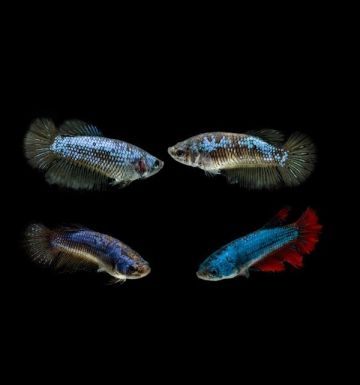
BETTA SPLENDENS FEMALE MIX / 3–4 CM
-
Code:280
-
Weight:0.100 Kgs
Female Betta Mix (Betta splendens Female Mix) is an assortment of female Siamese fighting fish in a variety of colours, patterns and fin shapes. Females usually have shorter fins than males, but retain the species’ characteristic beauty, intelligent behaviour and individual temperament. They are suitable for keeping alone or in a carefully planned aquarium with peaceful tankmates.
Quick Buy


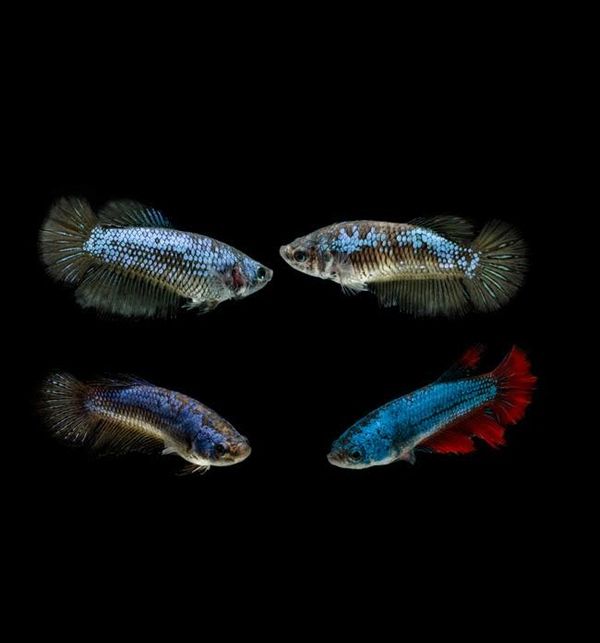

Female Betta Mix – a variety of colours and individual personalities
Female Betta Mix is a trade name for an assortment of female ornamental Betta splendens. The fish may be red, blue, green, white, yellow, black, multicoloured, marble-patterned, koi-patterned or a combination of different shades and patterns.
The label “Mix” means that the exact colour, pattern and fin type depend on the specimens available. The fish do not necessarily belong to a single genetically pure line, and each female has an individual appearance.
Although females are often described as more peaceful than males, they are also territorial fish with individual personalities. One female may be calm, while another may be highly dominant and aggressive. For this reason, keeping several females together should not be considered risk-free.
Appearance and distinguishing features
Female Betta splendens usually have a more compact body and shorter fins than long-finned males. However, selectively bred lines vary, and some females may develop relatively broad caudal, dorsal and anal fins.
Sexually mature females often have a small, pale egg spot between the pelvic and anal fins. This feature can help identify the sex, but should not be used on its own for very young or not fully developed specimens.
Horizontal or vertical bars may temporarily appear on the body during stress, submission or preparation for breeding. Colour intensity depends on genetics, age, health, lighting and aquarium conditions.
In marble and koi lines, the colours may continue to change with age. Therefore, it cannot be guaranteed that every fish will retain exactly the same colour pattern it had initially.
Key parameters
| Scientific name | Betta splendens |
| Trade name | Betta Female Mix |
| Common name | Female Betta Mix |
| Family | Osphronemidae |
| Origin | Selectively bred aquarium form; the wild species originates from Southeast Asia |
| Adult size | Approximately 5–7 cm, depending on the line and fin shape |
| Recommended aquarium | From 30 litres for one female; a considerably larger, densely planted aquarium is needed when kept with other fish |
| Temperature | 24–28°C |
| pH | 6.0–8.0 |
| Hardness | 5–19 dGH |
| Diet | Primarily animal-based foods – specialised pellets, frozen foods and live foods |
| Behaviour | Territorial, with an individual level of aggressiveness |
| Swimming zone | Upper and middle levels of the aquarium |
| Keeping | Safest when kept alone; may be kept with carefully selected peaceful tankmates |
| Care level | Easy to moderate, depending on the social setup |
Aquarium and proper care
A female betta should be kept in a fully cycled, heated and filtered aquarium. Small bowls and unheated decorative containers do not provide a stable temperature, enough space or reliable water quality.
An aquarium of at least 30 litres with enough horizontal swimming space is recommended for one female. A larger volume is more stable and allows better arrangements of territories, plants and quiet resting areas.
Filtration should be effective, but the current should be gentle and evenly distributed. Bettas come from slow-moving, calm waters and may become tired in a continuously strong current.
Ammonia and nitrite should always be at 0 mg/l, while nitrate should be kept low through moderate feeding and regular partial water changes. Sudden changes in temperature and water chemistry should be avoided.
Suitable live plants include Anubias, Cryptocoryne, Microsorum, Bucephalandra, Java moss and floating plants. Broad leaves near the surface provide comfortable resting places, while floating plants soften strong light and create a sense of security.
The aquarium should have a secure lid, as bettas can jump. Leave an air gap between the water surface and the lid. The fish must always have free access to the surface because it uses its labyrinth organ to breathe atmospheric air.
Behaviour and compatibility
The safest option is to keep one female betta alone in a well-furnished aquarium. This does not mean that the fish lacks social contact: bettas are not shoaling fish and do not need the company of other bettas to thrive.
In an appropriately sized and well-arranged aquarium, some females may live with peaceful, non-aggressive fish that do not nip fins or resemble rivals. Possible tankmates include some small rasboras, peaceful bottom-dwelling fish and snails, but compatibility always depends on the individual betta’s temperament.
Avoid aggressive fish, active species that chase or nip fins, and very brightly coloured, long-finned fish. Shrimp may be chased or eaten, especially smaller specimens and newly hatched shrimp.
A male and a female betta should not be kept together permanently. They should only be introduced under controlled conditions for breeding and separated if aggression occurs or once spawning is over.
Keeping several females together, known as a “sorority”, carries a real risk of chasing, chronic stress, injury and death. It requires a large, densely planted aquarium with many visual barriers, close monitoring and the ability to separate any fish immediately. It is not suitable for beginners.
Feeding
Female Betta splendens need food rich in high-quality animal protein. The staple diet can consist of specialised floating or slow-sinking betta pellets sized for their small mouths.
For variety, offer brine shrimp, daphnia, cyclops, glassworms, suitable bloodworm larvae and other safe live or frozen foods. Thawed food should not be refrozen.
Offer small portions once or twice a day. Bettas are prone to overeating and obesity, so control the portion size and remove any uneaten food.
Breeding
Betta splendens is a bubble-nest-building species. The male builds a nest near the surface, and if courtship is successful, the pair spawns beneath it.
After fertilisation, the male places the fallen eggs in the nest and guards them. The female should usually be removed after spawning, as the male may become highly aggressive towards her.
Breeding should take place in a separate, prepared aquarium and requires experience, close supervision and suitable first foods for the fry. A female from a commercial mix does not guarantee a particular colour or fin shape in the offspring.
Important features
- Female Betta Mix is an assortment of female bettas, not a separate variety or wild species.
- The exact colour, pattern and fin shape depend on the individual specimen available.
- Females usually have shorter fins than males, but can be just as colourful.
- Each female has an individual personality and level of territoriality.
- Female bettas are not shoaling fish and do not have to be kept in a group.
- The safest option is to keep one female on her own.
- Groups of females are not risk-free and are not recommended for beginners.
- A male and female betta should not live together permanently.
- The aquarium should be heated, filtered and fitted with a lid.
- The fish must have constant access to the water surface.
- Strong currents, cold water and sudden changes cause stress.
- In marble and koi specimens, the colouring may change with age.
Female Betta Mix from LiveFish Bulgaria
Female Betta Mix is a suitable choice for aquarists looking for a colourful, intelligent fish with a distinct personality. Each specimen offers a different combination of colours, patterns and behaviour.
With warm, stable water, a gentle current, high-quality food and a well-arranged aquarium, a female betta displays vivid colouring, curious behaviour and active interaction with her surroundings.
-
BETTA SPLENDENS FEMALE MIX / 3–4 CM
Price: €3.00 -
-
-
-
Who it’s for
Female Betta Mix is suitable for beginner and experienced aquarists looking for a colourful fish with an individual personality. A single female can be kept in a heated, filtered aquarium of at least 30 litres. Keeping several females together is considerably more challenging and is recommended only for experienced aquarists with a large, densely planted aquarium and the ability to separate the fish immediately if needed.
Key features
• Научно име: Betta splendens • Търговско име: Betta Female Mix • Българско име: Женска Бета Микс • Семейство: Osphronemidae • Тип: селекционна лабиринтова риба • Размер: около 5–7 см • Температура: 24–28°C • pH: 6.0–8.0 • Твърдост: 5–19 dGH • Препоръчителен аквариум: от 30 литра за една женска • Хранене: предимно животинска храна • Поведение: териториално, с индивидуално различна агресивност • Отглеждане: най-сигурно самостоятелно • Зона на обитаване: горна и средна зона • Ниво на трудност: лесно при самостоятелно отглеждане; умерено до високо при група
Unique differentiators
• A variety of colours and patterns • Each specimen has a distinctive appearance • More compact fins than those of most male bettas • Intelligent and curious behaviour • Suitable for a dedicated display aquarium • Can recognise the person who feeds it • Does not need the company of other bettas • Accepts specialised dry, live and frozen foods • Suitable for a planted aquarium with a gentle current • Its labyrinth organ allows it to breathe atmospheric air
Why this product
Choose Female Betta Mix if you are looking for a small, colourful and alert fish with a distinct personality. Each female has a different combination of colours, patterns and behaviours. When kept alone in a warm, filtered and well-planted aquarium, she is relatively easy to care for and makes an attractive centrepiece fish.
FAQ
Question: What does Female Betta Mix mean? Answer: It is a commercial assortment of female Betta splendens with different colours, patterns and fin types. The name does not refer to one specific genetic line.
Question: Can I choose a specific colour? Answer: The colour depends on the specimens available. The label “Mix” does not guarantee a particular colour, pattern or fin shape.
Question: How large does a female betta grow? Answer: It usually reaches around 5–7 cm, depending on the particular line, age and fin shape.
Question: What size aquarium does it need? Answer: A heated, filtered and well-planted aquarium of at least 30 litres is recommended for one female. A larger volume provides more stable water and more space.
Question: Can a female betta be kept in a bowl? Answer: This is not recommended. Bowls generally do not provide a stable temperature, suitable filtration, enough space or reliable water quality.
Question: Can several female bettas live together? Answer: Sometimes, but this carries a significant risk of aggression, chronic stress and injury. A large, densely planted aquarium with visual barriers is needed, along with the ability to separate any fish immediately.
Question: Is a group of females suitable for beginners? Answer: No. The safest option for beginners is to keep one female on her own.
Question: Can a male and female betta live together permanently? Answer: No. They should only be introduced under controlled conditions for breeding. Keeping them together permanently may lead to severe stress, chasing and serious injuries.
Question: Are female bettas peaceful? Answer: Not always. They are often less aggressive than males, but remain territorial, and their temperaments vary from one individual to another.
Question: Can a female betta live with other fish? Answer: Sometimes, if the aquarium is large enough and the tankmates are peaceful and do not nip fins. Compatibility also depends on the individual betta’s temperament.
Question: What does it eat? Answer: Suitable foods include specialised betta pellets, supplemented with brine shrimp, daphnia, cyclops and other safe live or frozen foods.
Question: Why does the betta come up to the surface? Answer: This is normal behaviour. Betta splendens has a labyrinth organ and periodically takes in atmospheric air from the surface.
Question: Is a lid necessary? Answer: Yes. Bettas can jump, so the aquarium should have a secure lid, with a layer of warm, humid air left above the water.
Question: Can its colour change? Answer: Yes. In some selectively bred lines, especially marble and koi varieties, the colour pattern may change as the fish ages.