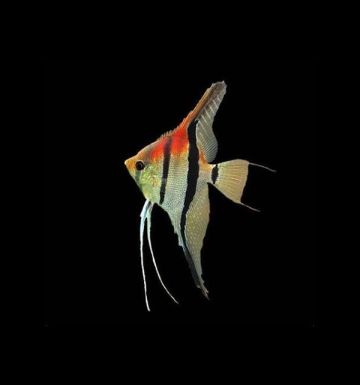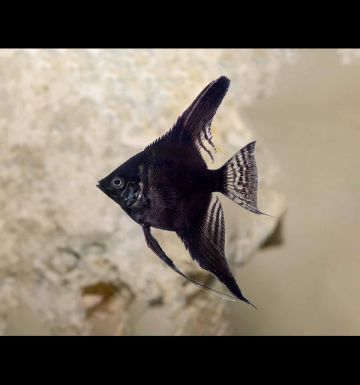
PTEROPHYLLUM SCALARE “LEOPARD” / 4 CM
-
Code:283
-
Weight:0.100 Kgs
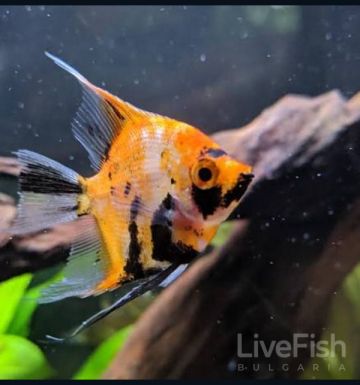
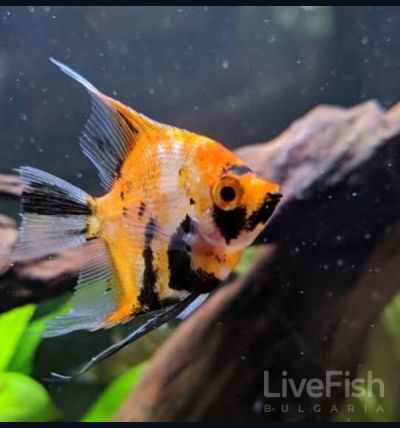
Leopard Angelfish (Pterophyllum scalare “Leopard”) is a striking selectively bred variety with distinctive dark spots, speckles and irregular patterns on a lighter-coloured body. Its tall silhouette, elongated fins and individual markings make each fish a unique centrepiece. It is suitable for a spacious, tall, well-filtered aquarium with peaceful fish that do not nip fins.
Quick Buy


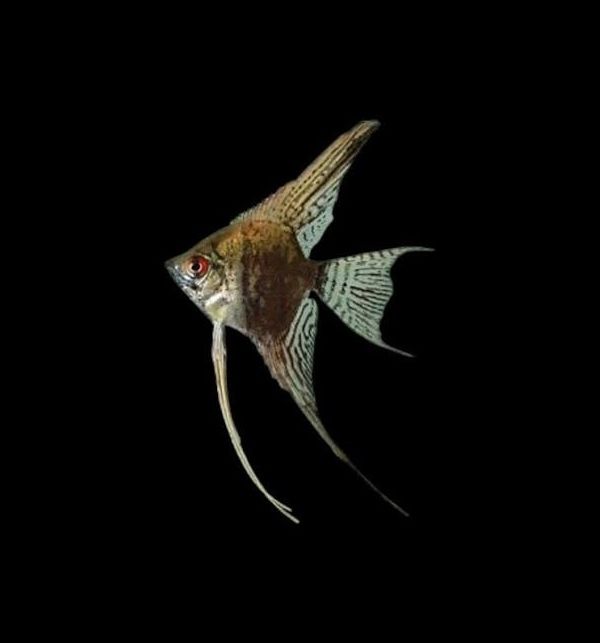

Leopard Angelfish – unique spotted colouring and an elegant silhouette
Leopard Angelfish is a selectively bred variety of Pterophyllum scalare, known for its complex spotted colouring. Its body and fins may display numerous dark spots, short lines, irregular blotches and remnants of vertical stripes that resemble a leopard’s coat pattern.
This is not a separate wild species or geographic form, but an ornamental phenotype produced through selective breeding. According to established angelfish genetics terminology, the classic Leopard phenotype is associated with an interaction between the Smokey and Zebra genes. However, the trade name does not always guarantee a specific genotype, as different breeders may offer lines with varying pattern intensity and distribution.
The pattern of young fish may change as they grow. Some spots may expand, merge or darken, while others become less visible. Therefore, it cannot be guaranteed that an adult fish will retain exactly the same pattern it had as a juvenile.
Appearance and distinguishing features
Leopard Angelfish has the tall, laterally compressed body characteristic of the species. Its long dorsal and anal fins form an elegant triangular silhouette, while its elongated pelvic fin rays move gracefully beneath the body.
The base colour may be silvery, greyish, brownish or darker, depending on the particular selectively bred line. Black to dark brown blotches, fine spots and broken lines appear across it. In some specimens, the pattern covers almost the entire body and fins; in others, it is concentrated in specific areas.
The intensity of the dark pigments varies with lighting, background, mood, social status and stress level. A calm fish in a suitable environment will usually display a clearer, more intense pattern.
Adults reach approximately 12–15 cm in body length, but their total height, including fully developed fins, may exceed 20–25 cm. The aquarium therefore needs to be not only long but also sufficiently tall.
Key parameters
| Scientific name | Pterophyllum scalare “Leopard” |
| Trade name | Leopard Angelfish |
| Common name | Leopard Angelfish |
| Family | Cichlidae |
| Origin | Selectively bred aquarium variety; the wild species originates from tropical South America |
| Adult size | Approximately 12–15 cm long, with a total height of over 20–25 cm when the fins are fully developed |
| Recommended aquarium | From 200 litres; 250 litres or more is recommended for a group of young fish, with a minimum length of 100–120 cm and a tall water column |
| Temperature | 24–28°C |
| pH | 6.0–7.5 |
| Hardness | 5–13 dGH |
| Diet | Omnivorous – high-quality pellets, flakes, frozen, live and plant-based foods |
| Behaviour | Relatively peaceful, with an established hierarchy and increased territoriality during breeding |
| Swimming zone | Middle level of the aquarium |
| Recommended group | At least 5–6 young specimens, with enough space for pairs to form |
| Care level | Moderate |
Aquarium and proper care
Leopard Angelfish should be kept in a fully cycled, spacious and tall aquarium with effective biological filtration. Small, shallow tanks do not provide enough room for the tall bodies and long fins of adult fish.
For a group of five or six young angelfish, an aquarium of at least 250 litres is recommended, with a length of 100–120 cm and a water column of around 50 cm or more. When pairs form and territorial behaviour intensifies, some specimens may need to be separated.
The water should be clean and stable. Ammonia and nitrite should always be at 0 mg/l, while nitrate should be kept as low as possible through moderate feeding and regular partial water changes. Sudden changes in temperature, pH and hardness should be avoided.
Filtration should provide effective biological and mechanical filtration without creating an excessively strong current. A continuous strong flow can make swimming difficult for fish with tall bodies and long fins, forcing them to seek shelter constantly.
The aquarium can be furnished with fine sand, tall plants, roots and open swimming areas. Suitable plants include Echinodorus, Vallisneria, Cryptocoryne, Anubias and other species that tolerate the temperature. Decorations should not have sharp edges that could damage the fins.
A darker background, natural roots and moderate lighting can highlight the spotted colouring. The aquarium should have a lid, as angelfish may jump out when startled.
Behaviour and compatibility
Young Leopard Angelfish do best in a group. A natural hierarchy develops, involving displays, brief chases and the claiming of preferred territories.
As they reach sexual maturity, pairs may form. They become territorial and defend their chosen area, especially when preparing to spawn. A large aquarium, plants and visual barriers help reduce conflict.
Suitable tankmates include peaceful medium-sized tetras, larger rasboras, warm-water Corydoras, peaceful catfish and other non-aggressive fish with similar water requirements.
Tiger barbs and other fin-nipping species are not recommended. Aggressive cichlids may injure angelfish, while overly active fish may constantly stress them or interfere with feeding.
Adult angelfish may see very small fish as food. Small shrimp and newborn fry are generally not safe either.
Feeding
Leopard Angelfish is omnivorous and needs a varied diet. Staple foods may include high-quality slow-sinking pellets, soft pellets or flakes formulated for angelfish and other medium-sized cichlids.
For healthy development, offer brine shrimp, daphnia, cyclops, mysis, glassworms and suitable bloodworm larvae. Live and frozen foods should come from a reliable source.
Foods containing spirulina and other plant ingredients provide a balanced diet. Varied feeding supports growth, the immune system and normal fin development.
The Leopard pattern is genetically determined. High-quality food can improve overall condition and support the natural expression of pigments, but it cannot create a spotted pattern in a fish without the necessary genetic inheritance.
Offer small portions once or twice a day. Uneaten food should be removed because it pollutes the water and increases the risk of health problems.
Breeding
Leopard Angelfish is an egg-laying fish that forms pairs. The most reliable way to obtain a compatible pair is to raise a group of young fish and allow them to choose their own partners.
Sex is difficult to determine from appearance alone. The most reliable differences can be observed around the genital papilla immediately before and during breeding.
The pair cleans a broad leaf, root, cone, filter pipe or section of glass. The female lays the eggs on the chosen vertical surface, and the male fertilises them.
Parents usually fan and guard the eggs, then move the larvae and protect the free-swimming fry. Young, inexperienced or stressed pairs may eat their first clutches.
To preserve a particular Leopard line, choose fish with clearly expressed and documented colouring. Crossbreeding with other varieties may produce offspring with different and unpredictable phenotypes.
Important features
- Leopard Angelfish is a selectively bred variety of Pterophyllum scalare, not a separate species.
- The classic Leopard phenotype is associated with an interaction between the Smokey and Zebra genes.
- The trade name does not always guarantee a specific genotype.
- The spotted pattern differs from one specimen to another.
- The pattern may change as the fish grows.
- Pigmentation intensity depends on genetics, conditions and stress level.
- Adults may exceed 20–25 cm in total height, including their fins.
- A tall, spacious aquarium is required.
- Young fish do best in a group of at least 5–6.
- Formed pairs become territorial during breeding.
- Very small fish and shrimp may be seen as food.
- Do not keep them with species that nip fins.
- Sex cannot be reliably determined from head and fin shape alone.
Leopard Angelfish from LiveFish Bulgaria
Leopard Angelfish is an excellent choice for aquarists looking for an elegant centrepiece fish with distinctive, complex colouring. Its tall silhouette, elongated fins and numerous dark spots make every specimen visually unique.
With a sufficiently tall aquarium, stable water conditions, a properly selected group and a varied diet, Pterophyllum scalare “Leopard” displays its spotted pattern at its best, along with the characteristic graceful behaviour of angelfish.
-
-
-
-
-
-
-
-
-
-
-
-
-
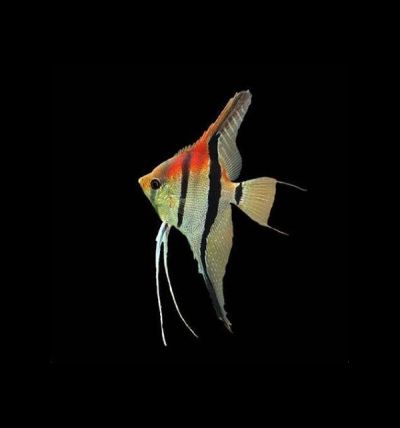
Pterophyllum scalare “Manacapuru” / 3–4 CM
Price: €15.00 -
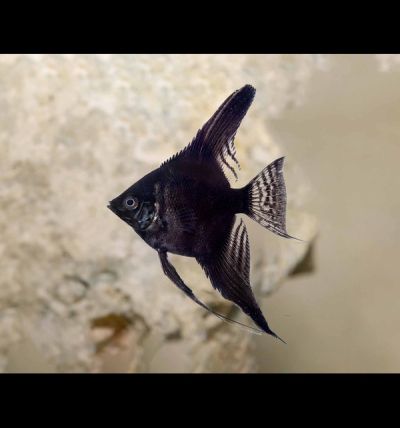
Pterophyllum scalare “Black” / 4-5 см
Price: €4.00
Who it’s for
• Научно име: Pterophyllum scalare “Leopard” • Търговско име: Leopard Angelfish • Българско име: Леопардова Скалария • Семейство: Cichlidae • Тип: селекционна сладководна скалария • Размер: около 12–15 см дължина и над 20–25 см обща височина • Температура: 24–28°C • pH: 6.0–7.5 • Твърдост: 5–13 dGH • Препоръчителен аквариум: от 200 литра • Аквариум за група: препоръчително 250 литра или повече • Минимална дължина: 100–120 см • Препоръчителна група: минимум 5–6 млади екземпляра • Хранене: всеядно • Поведение: сравнително спокойно, но териториално при размножаване • Зона на обитаване: средна зона • Ниво на трудност: умерено
Key features
• Scientific name: Pterophyllum scalare “Leopard” • Trade name: Leopard Angelfish • Common name: Leopard Angelfish • Family: Cichlidae • Type: selectively bred freshwater angelfish • Size: approximately 12–15 cm long and over 20–25 cm in total height • Temperature: 24–28°C • pH: 6.0–7.5 • Hardness: 5–13 dGH • Recommended aquarium: 200 litres or more • Aquarium for a group: 250 litres or more recommended • Minimum aquarium length: 100–120 cm • Recommended group: at least 5–6 young specimens • Diet: omnivorous • Behaviour: relatively peaceful, but territorial during breeding • Swimming zone: middle level • Care level: moderate
Unique differentiators
• Unique spotted colouring • Dark spots and irregular leopard-like markings • Each specimen has its own distinctive pattern • Tall, elegant body • Beautiful elongated fins • Graceful swimming • Suitable for a spacious planted aquarium • Interesting social hierarchy • Forms pairs • Shows parental care for eggs and fry
Why this product
Choose Leopard Angelfish if you are looking for a striking centrepiece fish with a unique spotted pattern. Its dark spots, irregular markings and elegant, tall silhouette make each specimen a distinctive focal point. In a spacious aquarium with stable water conditions and peaceful tankmates, Leopard Angelfish displays graceful swimming and interesting social behaviour.
FAQ
Question: Is Leopard Angelfish a separate species? Answer: No. It is a selectively bred variety of Pterophyllum scalare, developed for its distinctive spotted colouring.
Question: How does the leopard pattern develop? Answer: The classic Leopard phenotype is associated with an interaction between the Smokey and Zebra genes. However, the trade name does not always guarantee a specific genotype.
Question: Do all Leopard angelfish have the same pattern? Answer: No. The number, size and distribution of the spots are unique to each fish and depend on the particular selectively bred line.
Question: Does the colouring change with age? Answer: Yes. As the fish grows, spots and dark areas may expand, merge, darken or become less visible.
Question: How large does Leopard Angelfish grow? Answer: Its body reaches approximately 12–15 cm in length, while its total height, including fully developed fins, may exceed 20–25 cm.
Question: What size aquarium does it need? Answer: A tall aquarium of at least 200 litres is recommended. For a group of five or six young fish, 250 litres or more and a length of at least 100–120 cm are more suitable.
Question: How many angelfish should be kept together? Answer: Young fish do best in a group of at least five or six. As they grow, territorial pairs may form.
Question: Can a single angelfish be kept? Answer: Yes, but young angelfish display natural social behaviour in a group. To form a compatible pair, it is best to start with several young fish.
Question: Is Leopard Angelfish aggressive? Answer: It is usually relatively peaceful, but it establishes a hierarchy. Formed pairs become territorial when spawning.
Question: Can it live with small neon tetras? Answer: An adult angelfish may see very small fish as food. The risk is greater when small fish are added to an aquarium with angelfish that have already grown.
Question: Is it suitable for an aquarium with shrimp? Answer: It cannot be considered safe. Small shrimp and newborn shrimp are likely to be eaten.
Question: What does it eat? Answer: Suitable foods include high-quality pellets or flakes for angelfish, supplemented with brine shrimp, daphnia, cyclops, mysis and other safe live or frozen foods.
Question: How can its beautiful colouring be maintained? Answer: Good genetics, stable water, low stress levels and a varied diet are essential. Food cannot create the Leopard pattern in a fish without the necessary genetic inheritance.
Question: How can its sex be determined? Answer: Sex is difficult to determine from appearance alone. The most reliable differences can be seen around the genital papilla immediately before and during breeding.
Question: How does it breed? Answer: The pair cleans a vertical surface. The female lays the eggs on it, and the male fertilises them. The parents usually guard the eggs and care for the larvae.